
Publications and Patents
Publications
Anupam Kumar Garg, “Braille-8 – the Unified Braille Unicode System”, Jun 15, 2017, IEEE International Conference on Advanced Networks and Telecommunications Systems (ANTS), Bangalore, India, 2016.
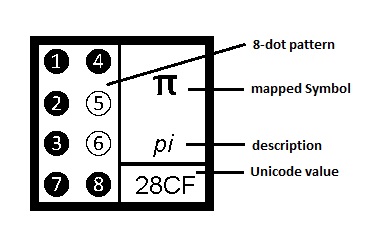
Abstract: Traditional Braille is a 6-dot code that can represent maximum 64 unique symbols with each braille cell. This is grossly insufficient to represent even ordinary English text (comprising 26 small letters, 26 capital letters, 10 digits, and 14 basic punctuations) — let alone math and science symbols. Thus a braille user has to enter 2 (and sometime 3 or 4) braille cells to enter one character or symbol. This makes braille writing very slow and tedious. Incidentally, 8-dot Braille Unicode was introduced to facilitate the Computer Braille that could represent all 95 computer characters with one braille cell itself. Since 8-dot braille can represent maximum 256 unique symbols, it has huge potential to provide the ultimate solution to all woes faced by braille users while writing texts (in English or in native languages) as well as mathematical and technical text. This paper presents a comprehensive unified braille Unicode system providing a detailed mapping of 8-dot braille Unicode pattern to represent the transcribing codes (in English or any other language) as well as the math, science, and computer symbols/characters — mostly with one braille cell itself.
Keywords: Computers; Encoding; Standards; Writing; Braille Unicode; Braille-8; blind; low-vision; braille pattern; braille standard; braille user; computer braille; eight-dot braille code; visually challenged
Patents
Anupam Kumar Garg, “Direct Braille Slate with Slate Base, Slate Frame, and Line Guide Unit”, International application number PCT/IN2019/050011, International publication number WO2019/138423A1 published on 18 July 2019
Patent description: In an embodiment, a direct-braille-slate includes a slate-base, a slate-frame, and a line-guide unit. The slate-base includes rows, each row includes cells, each cell includes fixed number of protruded pins to create embossed bump impressions on braille-paper when pressed using stylus. The slate-frame is hingedly coupled with slate-base on one end, and open at other end for inserting braille-paper in between slate-frame and slate-base. A line-guide-unit includes line-guides, each line guide hingedly coupled with an edge portion of slate-frame to move between a closed position and a flipped-open position. Each line-guide includes an elongated body including grooved cell-guides aligned over cells of a row of rows in closed position for creating embossed impressions on the braille-paper, and the row is accessible for reading embossed impressions in flipped-open position. Each line-guide is braille-numbered and has plurality of embossed marking at a fixed interval to locate row-column of braille-cells on the braille-paper.
Anupam Kumar Garg, “Apparatus for Drawing Embossed Geometrical Shapes and Constructions for Visually Challenged and Visually Impaired Users”, patent number 301636, appl. no. 201611040296, Issued on 28 September 2018
Patent description: An apparatus for drawing geometrical shapes and geometrical constructions for visually handicapped users. In an embodiment, the apparatus includes base plate, clamping mechanism, magnetic point markers, and a plurality of geometrical shape tracing members. The clamping mechanism is adapted to secure braille paper onto the base plate. The point marker is configured to be magnetically positioned at various portions of the base plate for creating an embossed point or a hole on the braille paper. The geometrical shape tracing members are configured to be supported over the point marker, where each geometrical shape tracing member is configured with a raised pattern representing a geometrical shape. The braille paper is pressed against the raised pattern using a stylus for creating an embossed geometrical shape or geometrical construction on the braille paper.
Anupam Kumar Garg, Sambit Dash, “Markers for Identifying Projected Graphics Objects in Object Stream”, patent number US8390616B1, Issued on 5 March 2013
Patent description: Methods and apparatus, including computer program products, for processing graphics objects in a model space with more than two dimensions. Information specifying a first view of the model space is received. The first view is defined by a projection of a first subspace of the model space onto a two-dimensional space. The first subspace includes at least a portion of two or more graphics objects. One or more markers are defined for the first view in the first subspace. Each marker for the first view is associated with at least one graphics object in a processing sequence for the first view. An object stream is generated, which includes projected objects that describe markers and graphics objects in the first view and are arranged in the object stream according to the processing sequence for the first view. Markers for the first view can be defined outside of any other view.